
HR Management Platform for Workforce Operations and Analytics is a case study about an internal system where the team delivered a unified digital environment for personnel workflows, workforce analytics, KPI tracking, payroll-related logic, vacations, documents, secure file handling, and ERP-connected HR processes.
This project is presented in a generalized form. Some details and identifying elements are intentionally omitted due to confidentiality requirements and NDA restrictions.
HR software built as one operational platform for people, documents, and analytics
The business needed more than a simple employee registry or HR dashboard. It required a connected platform for personnel workflows, payroll-related operations, KPI tracking, vacations, forecasting, documents, and internal analytics.
As a result, the team delivered not a collection of disconnected interfaces, but an HR platform with role-based access, analytics dashboards, document workflows, integrations, and secure handling of sensitive employee data.
Project Context
The company needed a digital environment where HR and personnel specialists could manage employee profiles, departments, payroll-related logic, accruals, schedules, vacations, performance metrics, and HR documents in one system.
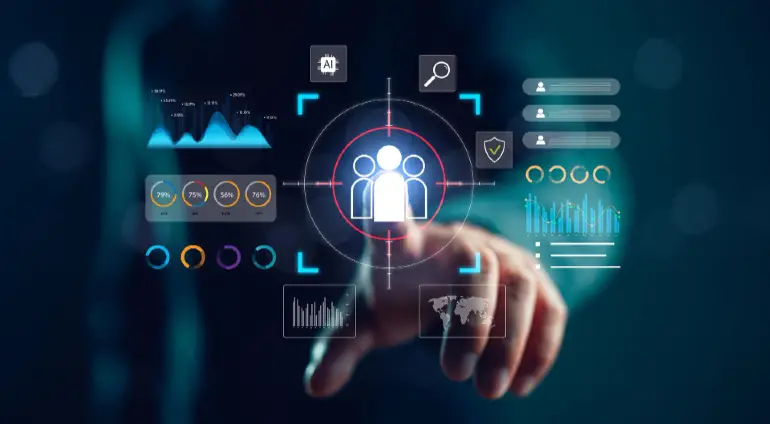
In addition to operational HR workflows, the platform had to support analytics scenarios: KPI tracking, workforce forecasting, performance visibility, workload management, and decision-support reporting. It also had to integrate with ERP and internal accounting systems while securely handling sensitive files and employee data.
What Was Delivered
HR Workspace and Role-Based Access
The platform served as the main workspace for HR and personnel specialists. It supported multiple HR roles, access policies, internal dashboards, and separate views depending on user responsibilities.
- single HR workspace;
- multiple HR and personnel roles;
- role-based access control and policies;
- operational interfaces and internal views;
- dashboards and management panels.
Employee Profiles and Organizational Structure
The system included employee cards, departments, personnel profiles, and change history within the company structure. This made it possible to work with employees as part of one connected HR data model.
- employee profiles and personnel cards;
- departments and organizational structure;
- HR profiles and change history;
- employee status and movement tracking;
- linking employee records to HR and accounting workflows.
Payroll, KPI, and Workforce Analytics
The platform supported payroll-related workflows, accruals, KPI tracking, workforce analytics, and forecasting. This made it possible to connect personnel data with performance and management-level decision-making.
- payroll-related logic and accruals;
- KPI and performance metrics;
- employee and role-based analytics;
- forecasting and workforce indicators;
- linking HR data to management analytics.
Schedules, Vacations, and Employee Lifecycle
The platform included schedules, vacations, absence planning, and workflows related to the employee lifecycle. This covered onboarding, offboarding, internal transfers, role changes, and related HR actions.
- schedules and vacations;
- absence planning;
- onboarding and offboarding;
- department transfers and position changes;
- history of HR actions for each employee.
Documents, Files, and Electronic HR Workflows
One of the core layers of the platform was HR document handling: contracts, orders, personnel files, templates, approval flows, electronic document workflows, and file-related scenarios.
- contracts, orders, and HR documents;
- electronic document workflows;
- document templates and approval routes;
- centralized file storage;
- role-based access to documents and file-related data.
Integrations and Internal HR Data Flows
The platform was connected to ERP and internal accounting-related systems. This made it possible to synchronize data, support imports and updates, and connect HR workflows with the company’s broader internal business environment.
Technology Architecture
The platform was built on a microservice architecture using Go for backend services and Vue.js / JavaScript for the web-based HR interface. Deployment and traffic routing were handled through Docker and Traefik, while delivery pipelines were built with GitLab CI/CD.
- Go, Vue.js, JavaScript;
- RabbitMQ and Redis;
- S3-compatible object storage;
- Docker, Traefik, GitLab CI/CD;
- Prometheus, Grafana, and Loki;
- centralized logging and platform monitoring.
Asynchronous Workflows, Caching, and Testing
RabbitMQ was used for background jobs, integration workflows, HR-related asynchronous processing, and document-related tasks, where controlled load handling and reliable execution were important. Redis served as a cache layer for dashboards, UI responsiveness, and frequently accessed data.
Key business workflows, APIs, integrations, and other critical parts of the platform were covered by tests to support stability during ongoing development.
Security and Sensitive Data Access
Security was one of the core architectural concerns of the platform. The system worked with sensitive employee data, HR documents, and private files, so access was governed through role-based permissions and access policies.
Files were stored in a centralized S3-compatible storage layer, sensitive data was protected through encrypted handling, and file access was restricted based on role, department, and HR workflow context. Audit trails, change history, and controlled access to documents were part of the base platform logic.
Business Value
For the business, the platform became more than an HR interface. It provided one connected digital environment for people operations, personnel documents, analytics, forecasting, and controlled access to HR data.
- centralized HR and personnel workflows;
- better visibility into workforce data and HR metrics;
- reduced manual workload for HR and personnel teams;
- faster access to analytics, KPI, and forecasting;
- simplified document workflows and approvals;
- connected HR operations with ERP and internal systems;
- secure handling of files and sensitive employee data;
- a stronger base for management decisions related to workforce efficiency.
Result
Instead of relying on disconnected HR processes, the company gained a connected HR platform with analytics, documents, secure files, forecasts, integrations, and role-based access. This created a more manageable digital foundation for workforce operations, internal HR development, and better visibility into personnel data.